
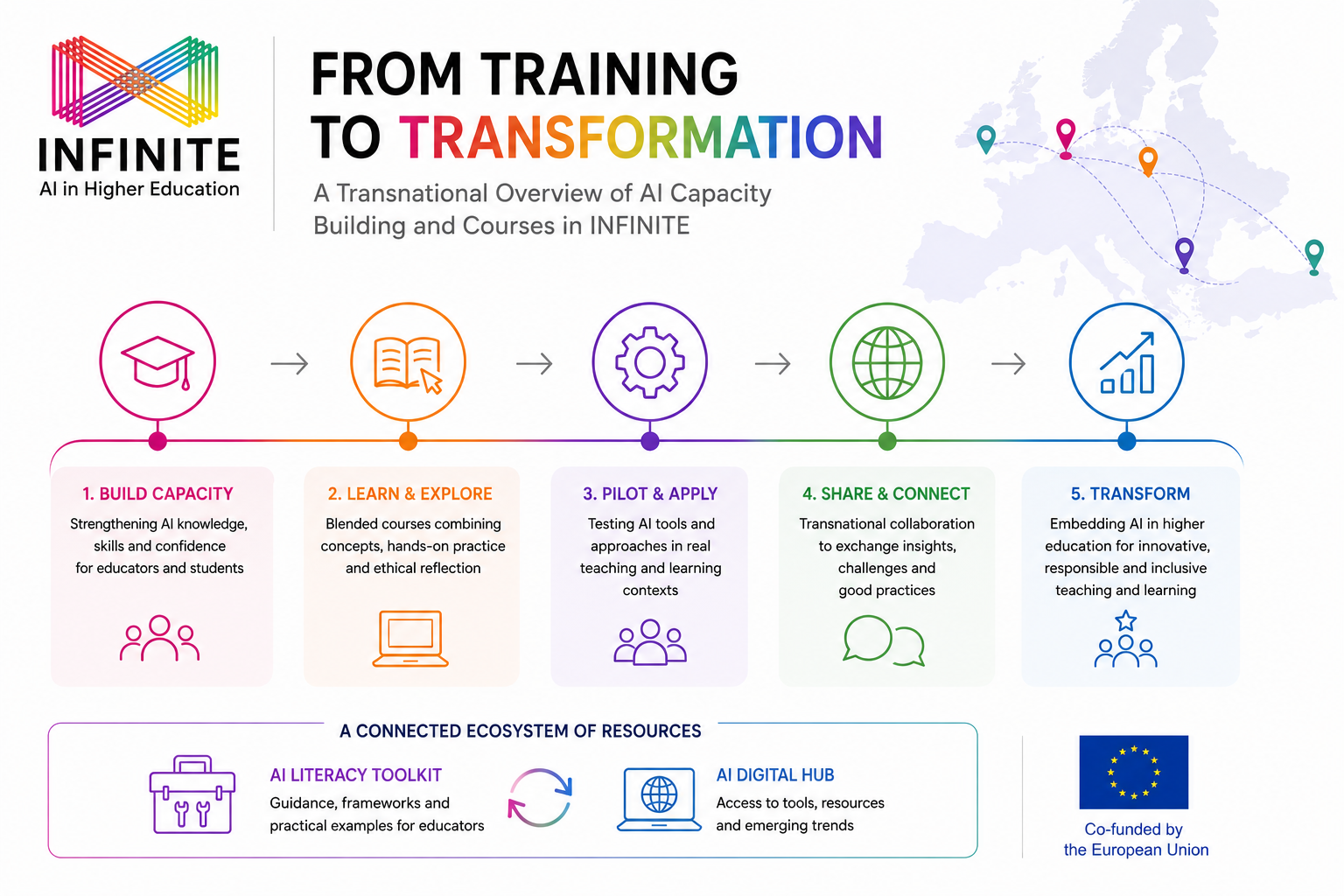
As Artificial Intelligence (AI) continues to reshape higher education, institutions across Europe are gradually moving beyond initial curiosity and experimentation. The question is no longer whether AI should be used, but how it can be integrated in ways that are meaningful, responsible, and pedagogically sound.
Within the INFINITE project, the work on WP4: AI Capacity Building and Courses responds directly to this challenge. By bringing together experiences from multiple European countries, it focuses on equipping educators and students with the knowledge, skills, and confidence needed to engage with AI in real educational contexts.
Across the project, dozens of educators and students from partner institutions participated in training and pilot activities, contributing to a rich, practice-based understanding of how AI can be applied in higher education.
Building Capacity Across European Contexts
The activities were implemented across diverse institutional and national environments, including the Netherlands, Greece, Ireland, Cyprus, and Belgium, involving participants with different levels of familiarity with AI. Some were already experimenting with AI tools in their teaching, while others were being introduced to the topic for the first time.
Despite these differences, a shared need quickly became evident. Educators and students alike are looking for structured support that goes beyond theory—support that helps them understand how AI can be used in practice, within the realities of higher education.
The transnational dimension played a key role here. By working across these different contexts, the project was able to identify common challenges and priorities, while also benefiting from a variety of perspectives and approaches.
From Learning About AI to Using It
At the core of this work are the blended courses developed for higher education academics and students. These courses were designed to move beyond abstract discussions of artificial intelligence and focus instead on its practical application in teaching and learning.
Participants consistently highlighted the value of this approach. The combination of conceptual understanding with hands-on exploration allowed them to better grasp both the potential and the limitations of AI tools. Whether in designing course activities, supporting student learning, or reflecting on assessment practices, the courses provided a space to experiment and reflect.
Importantly, the courses also addressed the ethical dimension of AI. Participants were encouraged not only to use AI tools, but to question them—considering issues such as transparency, bias, and responsible use.
Learning Through Piloting and Practice
A key strength of the activities lies in their implementation in real educational settings. The courses were piloted within higher education institutions, allowing participants to directly apply what they were learning.
This practical engagement proved essential. It enabled educators to test new approaches in their teaching and gave students the opportunity to interact with AI tools in authentic learning environments. As a result, feedback was grounded in real experience rather than hypothetical scenarios.
As one participant noted:
“I will incorporate them into my course.”
This simple statement reflects a crucial outcome of the work—not just awareness, but actual intention to apply the project results in practice.
Common Insights Across Countries
While the implementation contexts differed, several shared insights emerged from the transnational experience.
There is a strong and consistent demand for practical guidance. Participants are not looking for more information about AI in general, but for concrete examples, frameworks, and resources that can be applied immediately.
At the same time, the importance of ethics and critical thinking was emphasised across all contexts. AI is seen not just as a technological tool, but as a factor that influences decision-making, teaching practices, and learning processes.
Finally, the experience highlighted the role of institutions. Individual motivation and interest are high, but long-term impact depends on institutional support. Integrating AI into higher education requires not only training, but also strategic alignment and continuous professional development.
A Connected Ecosystem of Resources
The work on AI Capacity Building and Courses is closely connected with other key results of the INFINITE project. The AI Literacy Toolkit provides structured guidance and practical examples for educators, while the AI Digital Hub offers access to tools, resources, and emerging trends.
Together, these elements form a coherent ecosystem that supports both learning and implementation. Training is reinforced by access to resources, and exploration of tools is guided by pedagogical and ethical considerations.
Looking Ahead
The transnational experience confirms that higher education institutions are ready to engage with AI, but also underlines the need for continued support.
Moving forward, the focus will be on strengthening practical application, expanding training opportunities, and supporting institutions in embedding AI into their practices. The transition from experimentation to systematic integration is already underway.
In this context, the work on AI Capacity Building and Courses represents an important step—demonstrating how collaboration across countries can support meaningful and responsible innovation in higher education.
Ultimately, it reflects a broader shift: from understanding artificial intelligence as a concept, to actively shaping its role in education.